|
HOME | TROY | ISAAC | EDDY | MAX | SOPHIE | #6 | RED & WHITE | CONTACT ME |
MEET MY GUIDE DOGS
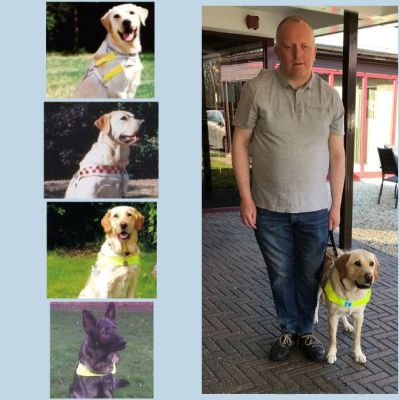
On this part of my website, I’d like to introduce you to the five beautiful guide dogs I’ve had the greatest of pleasure working with: Troy, Isaac, Eddy, Max, and Sophie. To see photos and read about them, please click on their names at the top of each page.
INTRODUCTION
I was trained to use a long cane well over a year before I first applied for a guide dog. In 1983, I’d gone to Nelson in Lancashire with my close friends, Philip and Gwyneth, and their two boys, Matthew and Timothy. While there, we visited the breathtaking Ingleton Waterfalls. At one point, I was stood with my back remarkably close to an exceptionally steep drop, and I wasn’t even aware of it! Philip was panicking because it would have been no more than a couple of steps back and I’d have totally disappeared! He didn’t want to reach out and touch my arm as he was really worried doing that might make me step back. So, trying his best not to sound in a panic and being verbally gentle, he successfully encouraged me to take several steps forward, safely away from that terrifying drop! Thank you Philip!
It was while we were in Lancashire that he began noticing just how bad my eyesight was getting, and a little later he plucked up the courage to have a tactful chat with me about asking for help with my mobility needs, which is how my training course on how to use a long white cane got under way.
I still had a small amount of somewhat useful central vision, although its usefulness was definitely getting less. My Mobility Instructor, Malcolm Jones, told me I needed to use my long cane as if I couldn’t see anything at all. The reason was that if people around town saw me avoiding things that my long cane hadn’t found, they’d get used to it. Then when I’d lost my remaining sight, they might assume I could still see to a certain degree.
I remember one day while walking through town, I came to the corner of a street where I needed to cross over. Straight ahead of me I could see two old gentlemen enjoying a chat, their bags of shopping placed at their feet. All I could hear was Malcolm telling me to ignore anything I can see. So, I began honing in on my unsuspecting victims like a guided missile! They must have wondered what on earth was going on as my long white cane started swiping through their shopping. Thankfully the penny dropped quickly, and grabbing up their bags, they helped me safely past while apologising profusely.
On another occasion as I was walking down through town, I spotted a lady carrying boxes coming out of a shop doorway in front of me. The boxes went way above her eye level, and were obscuring her vision. As she tripped over the end of my long cane, the boxes scattered in all directions. Another afternoon when I was walking back home from town around school kicking-out time, I spotted a girl running straight at me down the pavement. Still hearing Malcom’s words in my mind, I just carried on, but she kept running straight at me. I felt sure she was going to change direction slightly and run past me. She was still running straight at me when she fell over my long cane, bending it in the process, and disappearing over to my left narrowly missed going under a bus that was about to pull up at a bus stop! How she didn’t end up under its wheels I will never know!
Shortly after my application for a guide dog was submitted, I was assessed at home. The South Wales area was under the care of the Guide Dogs training centre at Cleve House in Exeter at the time, and I was single and still living with my parents and sister. I can clearly remember standing at our garden gate and being asked how far I could see. I looked along our road and said I could see the shelter at the bus stop. The bus stop in question was well over 100 yards away! “That’s torn it . . .” I thought to myself, but I was then asked to concentrate on the shelter and say what I could see in between it and us. “Nothing . . .” I said. The problem was I was born with Retinitis Pigmentosa, causing me to suffer from tunnel vision. So, anything outside my central vision was literally out of sight. That’s not to say it was like looking through a cardboard tube, it wasn’t dark or black. It was more like when you look at a photo of a bird sat on a branch. The bird is in sharp focus, but everything else around it is blurred or out of focus. Thankfully, that was sufficient for me to be placed on the waiting list for a guide dog.
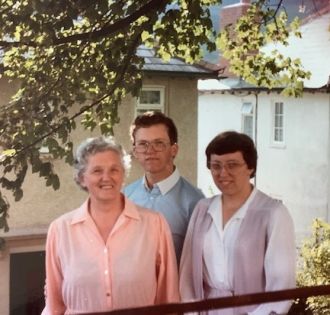
Many years later while doing a small amount of research into Retinitis Pigmentosa, I discovered that one of the primary causes is where a man and woman – who share the same grandparents – have children together. Having traced a good deal of my family’s history, I knew that my maternal great great grandparents, William Godwin and Emily Gray who were both from Nailsea near Bristol, were indeed first cousins. To top it off, further research revealed that William’s grandparents, Benjamin Godwin and Ann Doggett, were first cousins once removed. My mum’s family had absolutely no idea where her blindness had come from, it was a complete mystery to them. She was the only one in her family to inherit “RP” as it’s referred to. Both my sister and I inherited RP from mum, but my sight deteriorated far more quickly than my sister’s did. Thankfully, there was something else I inherited from mum, her sense of humour! As I grew up, I often heard her laughing and joking about her blindness. This definitely played a part in helping me to cope with losing my own sight. Although it didn’t make this time in my life extremely easy to deal with, it certainly helped to take the edge off things.
In April 1985, I was registered totally blind. It confused me at first as I thought I’d need to have absolutely no sight at all to be registered as totally blind. The consultant explained to me that it was worked out on percentages, and my test results placed me right on the border between partially and totally blind. He also said that because of the speed my sight was deteriorating, it made more sense to register me as totally blind as it would only be a matter of a few months before I’d have to go back to be re-registered.
By the time a suitable dog had been found for me, and I’d been invited to go on class in 1986, Su and I had been married for just a little while. We both felt that the house we’d moved into wasn’t suitable for a guide dog as there was no garden. We hadn’t purposely chosen a house without a garden, we were led to believe that the area at the back of the house was ours when in fact it wasn’t. We didn’t find that out until one day when a large digger and building materials suddenly appeared on it! Our actual area was a 1-metre wide path which was also a right of way. On that basis, I told Guide Dogs my circumstances had changed, but I didn’t clarify in what way. Come to think of it, I wasn’t asked either. Over the years, we’ve met and heard of people who have successfully coped with having a guide dog while living in a house with little or no garden. If only we’d told them what had caused my circumstances to change, they would have discussed the issue with us and my training would most likely have gone ahead.
After a thankfully rare mishap where my face met the wing mirror of a lorry that was overhanging the pavement, Su said it was high time to think about re-applying for a guide dog! When she first saw me after that incident, she thought I’d been beaten up. By this time, my maternal grandparents’ circumstances had also drastically changed. My grandmother had passed away at the age of 83, and my 84 year-old grandfather was too frail to look after himself and had moved in with one of his sons and daughters-in-law in Whitchurch, a northern suburb of Cardiff. Su and I, along with our 6 month-old son Paul, had the opportunity of moving into their home – a place I’d known all my life, and where my mum had lived since she was about 9 years-old, until marrying my dad some 15 years later. This meant we really did have an ideal sized garden, and so I reapplied for a guide dog.
In the meantime, I continued getting out and about with my long cane, which I jokingly named Michael. There were times when I needed to take Paul out on my own, and as he was still young, holding his hand as we walked along really wasn’t an option. Su had the brilliant idea of getting a child carrier, something that was worth its weight in gold! If you’re unsure what I’m referring to, it’s similar in design to a backpack with thick padded straps that go over your shoulders and under your arms. Instead of having storage compartments, it has a sling-seat for a young child to sit in. The one we bought was made of a strong but lightweight aluminium frame, with a comfy sling-seat. Well, I assume it was comfy as Paul never complained. Paul also wore a harness that clipped onto the frame which kept him nice and safe. I absolutely loved taking him out for walks, it gave me an incredible sense of independence.
From a very young age, Paul seemed to understand that dad couldn’t see anything at all. I remember one day when our little nephew Edward was crawling across our living room carpet. Paul spotted me heading straight for Edward and got himself over to me as fast as he could in his walker. I could hear his walker rattling across the room towards me, then grabbing my right trouser leg with both hands, he gave an almighty tug, telling me very clearly that he wanted me to move to my right. His quick action kept little Edward well out of harm’s way!
Over time, Paul even developed his own technique of warning me that something was in our way when we were out together. Sometimes I heard “dad!” in my ear, felt a vigorous tap-tap-tap on my shoulder – or even both. We’d slow down a bit, negotiate the obstacle, and then continue on our way. I suppose you could say he was my first little guide dog, a two-legged one! He could even warn me of something on the pavement he didn’t want me to tread in, using basic commands along the lines of: “Dad . . .” (tap-tap-tap) “Poo!”
Some well-meaning person (or people), horrified at seeing Paul and I getting out and about like this, reported me to Social Services. I had a phone call from someone at the department wanting to arrange a visit, where they could observe us, spot any potential problems and dangers, and take any necessary action. Thankfully, they could see how well-thought out it was, appreciated the safety aspect and the practicality of it, and gave us the green light to continue doing what we’d been doing. That was such a relief!
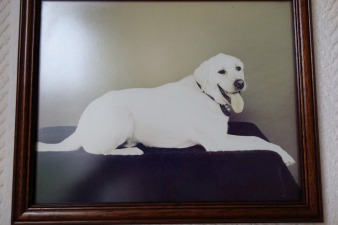
I was soon invited to attend a Guide Dogs assessment day at Cardiff. During that assessment, I was able to have a trial walk with a dog in training. What an experience that was! His name was Herbie, and he was nearing the end of his advanced training. It was decided that I met the criteria, and I was once again put on the waiting list. Me being me, I began convincing myself that they wouldn’t let me walk with a dog that wasn’t suited to me, so, Herbie must be the one they’re thinking of matching me with. Right?
Wrong! In June 1989, I spent three weeks at Trevillian House on Cathedral Road in Cardiff with my first guide dog, a Golden Retriever cross Yellow Labrador named Troy. Trevillian House had been opened in September 1986, and was now the training centre of Guide Dogs for South and Mid Wales. My mobility was about to change for the better, and not just a little but drastically!
MORE INFORMATION
If you or someone you know would like to apply for a guide dog, helpful information can be found on Guide Dogs’ official website. You can find out about the various ways you can make a donation, and learn what volunteering opportunities are available. You can also get in touch with your local Guide Dogs Community Team to request an official Guide Dogs Speaker to visit your club, group, institute, organisation or school to give a talk about the training and work of Guide Dogs, and hear first-hand how these “life-changers” vastly improve the mobility and quality of life for their visually impaired handlers.